To say it was a complete shock when I was diagnosed is an understatement
Breast cancer in men is rare. Around 390 men a year are diagnosed (less than 1 percent) compared to around 56,400 women, according to Cancer Research.
So, when Alan Morris’s wife noticed him scratching his chest after a swim in the sea, cancer wasn’t the first thing that came to mind.
“We were on the beach in Dover soaking up the last of the summer sun and initially we just put the itching down to the salt water in the sea,” says Alan.
That was three years ago when he was aged 74. The itching continued after he was back home that night and his wife checked him and discovered a lump, so he made an appointment with his GP to get it checked out.
“I hadn’t been feeling unwell, so I didn’t really think there was anything untoward to worry about. In fact, we went off on holiday while the tests were being run and pretty well put it out of our minds,” says Alan.
“To say it was a complete shock when I was diagnosed is an understatement.”
Alan had his left breast removed and started a course of chemotherapy followed later in the year by three weeks of radiotherapy. He believed and hoped that would be the end of it and it seemed like everything was clear, until another scan showed the cancer had spread to his bones.
Alan now needs treatment for the rest of his life consisting of two injections in his lower back once a month, plus one in his arm and tablets.
“I was having my treatment at Canterbury Hospital which on a good day can take around 40 minutes to drive from home but if traffic is heavy, it can easily take around an hour,” he says.
A ten-minute pre-chemo check sometimes found him at the hospital for more than 3 hours if it was a busy day. Alan asked one of the sisters at the hospital about the mobile unit he had seen parked up in the Tesco car park just ten minutes away from where he lives.
“I thought it would make my life so much easier if I could transfer my treatment to the unit,” says Alan who was delighted when he was told that was possible.
“The hospital does a great job, but it is always so busy. My wife used to have to come with me in case I wasn’t well enough after treatment to drive myself, so it took up a great deal of her time too.”
“It’s so different on the unit. You see the same faces and there is a huge amount of camaraderie. I am constantly singing the praises of the unit, I think it is just amazing. I always take part in the surveys to say how fantastic it is. It’s hard to properly put into words what a wonderful service it offers.
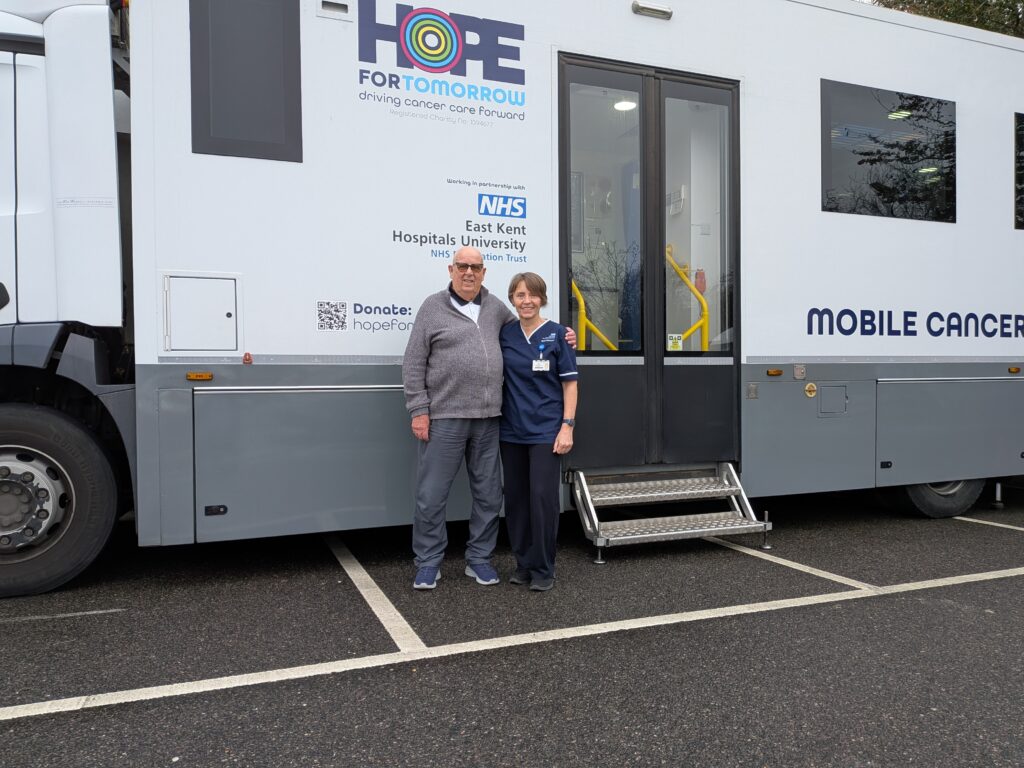
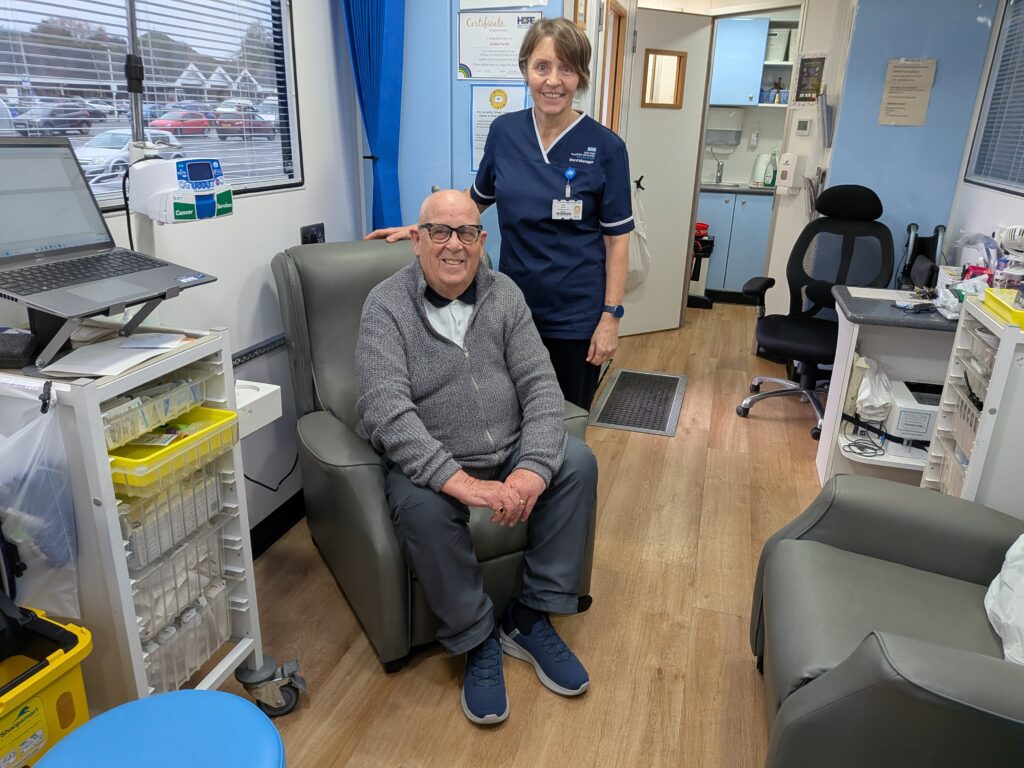
“I honestly couldn’t believe it when I heard it was supported by a charity and depended on fundraising to keep it going. I cannot speak highly enough of it. The people who work on the unit have become like family to me.
“It’s such a lovely community. It’s small and intimate. There’s usually only 3 or 4 people there and they are often the same faces, so you get to catch up and have a chat and there’s hardly any waiting time.
It has transformed my life. I no longer have hours of travelling and hanging around. Sometimes the sitting and waiting at the hospital was worse than the treatment.
“Parking at the hospital was the worst thing. My wife used to drop me off by the front door and then drive around trying to find a space. Just taking that out of the equation, has taken the stress out of it.”
A former postman and later a senior manager for Royal Mail, Alan took early retirement at 56 and he and his wife, a former teacher enjoyed travelling the world.
“We used to have 3 or 4 holidays abroad every year as well as trips in the UK but then our lives suddenly just seemed to be full of medical appointments.
“Cancer turned our world upside down and it’s now unrecognisable from what it used to be.
“The past three years have taken their toll, both on me and the people around me,” says Alan.
“That diagnosis changed our lives beyond belief but being able to have treatment on the unit makes me feel the treatments are not interfering too much with my day-to-day life.
“Since transferring to the mobile unit I don’t even think about it too much anymore. I just jump in the car and go. I can be back home again within an hour.
“I know all the staff there and if I am worried about anything I know I can call them. It’s just so convenient. I cannot speak highly enough of it.
“You really can’t compare it with a hospital. It creates such a different environment.”
“Friends find it incredible that I can go there and have my treatment. I always take the time to talk to them about how wonderful it is because there’s no doubt it has been life changing for me,” says Alan.
And he adds: “We’ve done a bit of fundraising for the charity and made a few donations as well as given raffle prizes and taken part in the pink ribbon lottery.
“We try and help in whatever way we can because I cannot thank them enough for the wonderful service they provide.
“The units must be a massive asset to the NHS, taking the pressure off the hospitals.”
For me, it’s been the difference between leaving 20 minutes to get to my appointment or well over an hour to sit in work and school traffic with no idea how long it’s going to take when I get there.
To say it was a complete shock when I was diagnosed is an understatement
Breast cancer in men is rare. Around 390 men a year are diagnosed (less than 1 percent) compared to around 56,400 women, according to Cancer Research.
So, when Alan Morris’s wife noticed him scratching his chest after a swim in the sea, cancer wasn’t the first thing that came to mind.
“We were on the beach in Dover soaking up the last of the summer sun and initially we just put the itching down to the salt water in the sea,” says Alan.
That was three years ago when he was aged 74. The itching continued after he was back home that night and his wife checked him and discovered a lump, so he made an appointment with his GP to get it checked out.
“I hadn’t been feeling unwell, so I didn’t really think there was anything untoward to worry about. In fact, we went off on holiday while the tests were being run and pretty well put it out of our minds,” says Alan.
“To say it was a complete shock when I was diagnosed is an understatement.”
Alan had his left breast removed and started a course of chemotherapy followed later in the year by three weeks of radiotherapy. He believed and hoped that would be the end of it and it seemed like everything was clear, until another scan showed the cancer had spread to his bones.
Alan now needs treatment for the rest of his life consisting of two injections in his lower back once a month, plus one in his arm and tablets.
“I was having my treatment at Canterbury Hospital which on a good day can take around 40 minutes to drive from home but if traffic is heavy, it can easily take around an hour,” he says.
A ten-minute pre-chemo check sometimes found him at the hospital for more than 3 hours if it was a busy day. Alan asked one of the sisters at the hospital about the mobile unit he had seen parked up in the Tesco car park just ten minutes away from where he lives.
“I thought it would make my life so much easier if I could transfer my treatment to the unit,” says Alan who was delighted when he was told that was possible.
“The hospital does a great job, but it is always so busy. My wife used to have to come with me in case I wasn’t well enough after treatment to drive myself, so it took up a great deal of her time too.”
“It’s so different on the unit. You see the same faces and there is a huge amount of camaraderie. I am constantly singing the praises of the unit, I think it is just amazing. I always take part in the surveys to say how fantastic it is. It’s hard to properly put into words what a wonderful service it offers.
“I honestly couldn’t believe it when I heard it was supported by a charity and depended on fundraising to keep it going. I cannot speak highly enough of it. The people who work on the unit have become like family to me.
“It’s such a lovely community. It’s small and intimate. There’s usually only 3 or 4 people there and they are often the same faces, so you get to catch up and have a chat and there’s hardly any waiting time.
It has transformed my life. I no longer have hours of travelling and hanging around. Sometimes the sitting and waiting at the hospital was worse than the treatment.
“Parking at the hospital was the worst thing. My wife used to drop me off by the front door and then drive around trying to find a space. Just taking that out of the equation, has taken the stress out of it.”
A former postman and later a senior manager for Royal Mail, Alan took early retirement at 56 and he and his wife, a former teacher enjoyed travelling the world.
“We used to have 3 or 4 holidays abroad every year as well as trips in the UK but then our lives suddenly just seemed to be full of medical appointments.
“Cancer turned our world upside down and it’s now unrecognisable from what it used to be.
“The past three years have taken their toll, both on me and the people around me,” says Alan.
“That diagnosis changed our lives beyond belief but being able to have treatment on the unit makes me feel the treatments are not interfering too much with my day-to-day life.
“Since transferring to the mobile unit I don’t even think about it too much anymore. I just jump in the car and go. I can be back home again within an hour.
“I know all the staff there and if I am worried about anything I know I can call them. It’s just so convenient. I cannot speak highly enough of it.
“You really can’t compare it with a hospital. It creates such a different environment.”
“Friends find it incredible that I can go there and have my treatment. I always take the time to talk to them about how wonderful it is because there’s no doubt it has been life changing for me,” says Alan.
And he adds: “We’ve done a bit of fundraising for the charity and made a few donations as well as given raffle prizes and taken part in the pink ribbon lottery.
“We try and help in whatever way we can because I cannot thank them enough for the wonderful service they provide.
“The units must be a massive asset to the NHS, taking the pressure off the hospitals.”
For me, it’s been the difference between leaving 20 minutes to get to my appointment or well over an hour to sit in work and school traffic with no idea how long it’s going to take when I get there.